


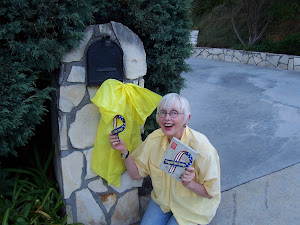


I have no idea if this is a true story--but it is a lovely one. It came to me in my e-mail, as so many stories do these days. Because no credit was given, I am publishing it anonymously because I think it is so important and because I think the author would intended for it to be passed around. I'm including a story of my own. The first one is mine. The second is the story (history?) of Taps.
Bob was my beloved first uncle. He served in WWII as a bomber pilot and died what seems to be yesterday at, I believe 81. Just before the funeral someone from his community (Ashland, OR) called to ask if Bob was a veteran. The answer, of course, "Yes."
"Then may I come by to play taps?"
That answer, of course, "Yes."
The bugler, acting on his own, stood an appropriate distance behind the graveside service so the sound was faint but so clear in the high Ashland altitude.
The universe takes good care of us all when we are sending out the right energy, just as it did this Union soldier. It is all about acceptance, after all.
Love,
Carolyn
>
> If any of you have ever been to a military funeral
> in which taps were played; this brings out a new meaning of
> it.
>
> Here is something Every American should know. Until I
> read this, I didn't know, but I checked it out and
> it's true:
>
> We in the United States have all heard the haunting
> song, 'Taps.' It's the song that gives us that
> lump in our throats and usually tears in our eyes.
>
> But, do you know the story behind the song? If not,
> I think you will be interested to find out about its humble
> beginnings.
>
> Reportedly, it all began in 1862 during the Civil
> War, when Union Army Captain Robert Ellicombe was with his
> men near Harrison 's Landing in Virginia . The
> Confederate Army was on the other side of the narrow strip
> of land.
>
> During the night, Captain Ellicombe heard the moans
> of a soldier who lay severely wounded on the field. Not
> knowing if it was a Union or Confederate soldier, the
> Captain decided to risk his life and bring the stricken man
> back for medical attention Crawling on his stomach through
> the gunfire, the Captain reached the stricken soldier and
> began pulling him toward his encampment.
>
> When the Captain finally reached his own lines, he
> discovered it was actually a Confederate soldier, but the
> soldier was dead.
>
> The Captain lit a lantern and suddenly caught his
> breath and went numb with shock. In the dim light, he saw
> the face of the soldier. It was his own son. The boy had
> been studying music in the South when the war broke out.
> Without telling his father, the boy enlisted in the
> Confederate Army.
>
> The following morning, heartbroken, the father asked
> permission of his superiors to give his son a full military
> burial, despite his enemy status. His request was only
> partially granted.
>
> The Captain had asked if he could have a group of
> Army band members play a funeral dirge for his son at the
> funeral.
>
> The request was turned down since the soldier was a
> Confederate.
>
> But, out of respect for the father, they did say they
> could give him only one musician.
>
> The Captain chose a bugler. He asked the bugler to
> play a series of musical notes he had found on a piece of
> paper in the pocket of the dead youth's uniform.
>
> This wish was granted.
>
> The haunting melody, we now know as 'Taps'
> used at military funerals was born.
>
> The words are:
> Day is done.
> Gone the sun.
> From the lakes
> From the hills.
> From the sky.
> All is well.
> Safely rest.
> God is nigh.
>
>
> Fading light.
> Dims the sight.
> And a star.
> Gems the sky.
> Gleaming bright.
> From afar.
> Drawing nigh.
> Falls the night.
>
> Thanks and praise.
> For our days.
> Neath the sun
> Neath the stars.
> Neath the sky.
> As we go.
> This we know.
> God is nigh
>
> I too have felt the chills while listening to
> 'Taps' but I have never seen all the words to the
> song until now. I didn't even know there was more than
> one verse . I also never knew the story behind the song and
> I didn't know if you had either so I thought I'd
> pass it along.
>
> I now have an even deeper respect for the song than I
> did before.
Anonymous
(I will happily credit if anyone claims it.)
> >
Those of you who are regular visitors to this blog will notice that you can now follow and your little avatar will appear front and foremost on the blog. I welcome you.
------
Carolyn Howard-Johnson wrote the foreword for Eric Dinyer's book of patriotic quotations, Support Our Troops, published by Andrews McMeel. Part of the proceeds for the book benefit Fisher House. Her chapbook of poetry won the Military Writers Society of America's award of excellence. Find it at http://www.amazon.com/gp/product/1599240173/
Showing posts with label wwii. Show all posts
Showing posts with label wwii. Show all posts
Saturday, May 2, 2009


Monday, April 28, 2008
A New True Story Book on WWII's Greatest Submariner
I thought visitors to War. Peace. Tolerance. might be interested in this new book by James W. MacMeekin. Here is the information on it:
Book title: Richard O'Kane and the Sinking of the Forty-Nine.
Subtitle: The True Story of WWII's Greatest Submariner"
349 pages
$18.95
Author: James W MacMeekin
Publisher: Three Rivers Books (863) 294-1323
Synopsis: Commander O'Kane revolutionized the offensive use of WWII submarines from that of a reconnaissance and underwater attack vehicle of opportunity, to that of a speedy surface vessel, capable of massive destruction, and the ability to outrun pursuing Japanese destroyer escorts. His wartime record proves the efficacy of his actions: 49 enemy ships rusting on the bottom of the might Pacific.
Cover art can be viewed at www.militarywriters.com. Go to the Book Store link, then look under Authors, under M for MacMeekin. The book will be available later this week at www.macmeekinbooks.com, or immediately by calling publisher.
-----
Carolyn Howard-Johnson wrote the foreword for Eric Dinyer's book of patriotic quotations, Support Our Troops, published by Andrews McMeel. Part of the proceeds for the book benefit Fisher House. Her chapbook of poetry won the Military Writers Society of America's award of excellence.
Saturday, April 12, 2008
Remembering Dachau and Other Things We'd Sooner Forget

Note from Carolyn: This is published anonymously from those missives sent around on the web with no attribution. I feel the author will forgive me. I also must note that most of us would rather deny that which offends us or reflects poorly on us. That is part of the human condition. Only those with courage own up to the reality of whatever they dislike most about their own past. That might include horrors perpetrated by our own government during this war. Tolerance is born of remembering.
The photo is of Eisenhower in Dachau.
It is a matter of history that when Supreme Commander of the Allied Forces, General Dwight Eisenhower, found the victims of the death camps, he ordered all possible photographs to be taken, and for the German people from surrounding villages to be ushered through the camps and even made to bury the dead.
He did this because he said in words to this effect: 'Get it all on record now - get the films - get the witnesses - because somewhere down the track of history some bastard will get up and say that this never happened. All that is necessary for the triumph of evil, is for good men to do nothing'.
This week, the University of Kentucky removed The Holocaust from its school curriculum because it 'offended' the Muslim population which claims it never occurred.
This is a frightening portent of the fear that is gripping the world and how easily each country is giving into it.
It is now more than 60 years after the Second World War in Europe ended.
This e-mail is being sent as a memorial chain, in memory of the 6 million Jews, 20 million Russians, 10 million Christians and 1,900 Catholic priests who were murdered, massacred, raped, burned, starved and humiliated with the German and Russian peoples looking the other way!
Now, more than ever, with Iran, among others, claiming the Holocaust to be 'a myth,' it is imperative to make sure the world never forgets. This e-mail is intended to reach 40 million people worldwide!
Be a link in the memorial chain and help distribute this around the world. Don't just delete this. It will only take a minute to pass this along.
-----
Carolyn Howard-Johnson wrote the foreword for Eric Dinyer's book of patriotic quotations, Support Our Troops, published by Andrews McMeel. Part of the proceeds for the book benefit Fisher House. Her chapbook of poetry won the Military Writers Society of America's award of excellence.
Saturday, January 19, 2008
Women and Others: Whys and Wherefores of Joining the Military

I thought this story from a woman soldier was interesting because it explains why women (and many others) might choose a military career. Thank you, Terry!
Guest blog by Terry Spear, Retired LTC, USAR
Why join the military?
From a many great-grandfather, who was a German mercenary, ordered to fight the Americans on the side of the British during the American Revolution, but fled the country and became a Canadian militiaman (he was so impressed by George Washington, several of his descendents were name GW), to my French-born great grandfather who was a Teddy Roosevelt Rough Rider, to my grandfather, a doctor in the Canadian Army, WWI, and my father, who was in the USAF, a prisoner-of-war of the Germans for 19 months when he was 17 during WWII, my mother, who joined the Army to get her US citizenship earlier (she was Canadian born), and a sister, also an Army officer, I joined the military because it was in my blood.
Service to country is really important to me. I was one of the first women commissioned in the US Army Reserve Office Training Corp who had been through the basic summer camp. After graduating as a Distinguished Military Graduate (DMG), I served as a personnel officer, and then as a mobilization officer, retiring as a LTC in the USAR.
When I first was commissioned, women were members of the Women’s Army Corp. But that soon changed and we were integrated into the all man’s Army. Our uniforms changed like the seasons. When I first arrived at my Personnel Officer’s Basic Course, we wore “cords,” a green and white striped blouse and skirt. Men wore khakis. This soon changed to a one-piece mint green dress for women. Civilians seeing me in uniform thought I was a Girl Scout Leader or an airline stewardess. True, it didn’t look anything like a uniform! Then shortly after that, we wore green pants, turtlenecks, white shirts, green skirts, which didn’t last either. Believe me, for the female officers, it was costing us a fortune! Next, they decided on a green skirt (couldn’t keep the one we already had) and a green blouse, which is still in use today.
Why join the military? I met people from all over the world, made friends from all over, enjoyed serving my country and my fellow soldiers, and now belong to a retired officer’s group locally. I’ve written about my father’s WWII experiences for the Ex-POW Bulletin, trying to keep the history alive, because our veterans are the ones who made us free.
-----
War. Peace. Tolerance and Our Soldiers is a blog by Carolyn Howard-Johnson. She wrote the foreword for Eric Dinyer's book of patriotic quotations, Support Our Troops, published by Andrews McMeel. Part of the proceeds for the book benefit Fisher House. Her chapbook of poetry won the Military Writers Society of America's award of excellence.
Saturday, December 22, 2007
Charlie Wilson's War: A Movie By and About Heroes
Charlie Wilson's War is a movie that took many heroes to make. George Crile, the amazing journalist/war reporter who wrote the book, Aaron Sorkin who has a knack for bringing unpleasant truths to the general public, Mike Nichols who does the same and manages to apply his incredible humor to them to make them palatable. Then there is Charlie Wilson himself, his helpmate Gust Avrakotos, his inspiration, Joanne Herring, Tom Hanks and Julia Roberts who use their celebrity to encourage large numbers to consider what their government has been up to and what it may be up to.
I just completed a review for the Glendale News-Press. It is schedule to run Thursday, Dec. 28, for those who would like to see the entire thing. Here is a quotation from it:
"When Joanne questions him about the covert war they have just engineered, Charlie says, "There has never been anything like it . . . ." And there may not be. Charlie's War has its proud moments, its amazing moments, and many, many funny ones. But then there's that other sad thing about this movie, besides the fact that Crile never got to see his story on the screen. It's that that the war portrayed is really only unusual in its aspect of David-with-money against an unsuspecting Goliath. Since WWII there have been more than 300 so-called conflicts (as counted by the Red Cross in attendance) similar to the Afghan-Soviet war. Refugees. Suffering of children. Horrors unmentionable on the parts of the military and their governments. Unlike WWII -- a war we left with dignity -- we left this Afghan war and many other conflicts callously with little or no care for the war-stricken. We left them mo peace. Much poverty. We left them seeds for radicalism."
-----
Carolyn Howard-Johnson occasionally reviews movies for the Glendale News-Press, an LA Times affiliate. She wrote the foreword for Eric Dinyer's book of patriotic quotations, Support Our Troops, published by Andrews McMeel. Part of the proceeds for the book benefit Fisher House. Her chapbook of poetry won the Military Writers Society of America's award of excellence.
Subscribe to:
Posts (Atom)


